


Page 3 - TRADITIONAL-HOUSE-OF-THE-JEBALLI-PEOPLE
P. 3
237


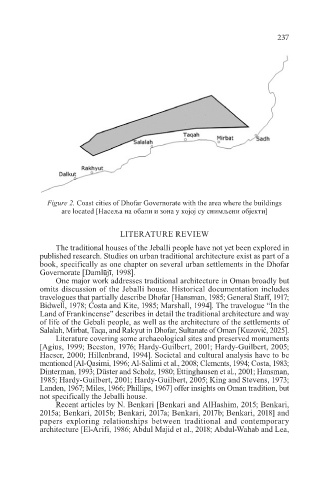
              Figure 2. Coast cities of Dhofar Governorate with the area where the buildings
                   are located [Насеља на обали и зона у којој су снимљени објекти]


                                   LITERATURE REVIEW

                 The traditional houses of the Jeballi people have not yet been explored in
            published research. Studies on urban traditional architecture exist as part of a
            book, specifically as one chapter on several urban settlements in the Dhofar
            Governorate [Damlūjī, 1998].
                 One major work addresses traditional architecture in Oman broadly but
            omits discussion of the Jeballi house. Historical documentation includes
            travelogues that partially describe Dhofar [Hansman, 1985; General Staff, 1917;
            Bidwell, 1978; Costa and Kite, 1985; Marshall, 1994]. The travelogue “In the
            Land of Frankincenseˮ describes in detail the traditional architecture and way
            of life of the Gebali people, as well as the architecture of the settlements of
            Salalah, Mirbat, Taqa, and Rakyut in Dhofar, Sultanate of Oman [Kuzović, 2025].
                 Literature covering some archaeological sites and preserved monuments
            [Agius, 1999; Beeston, 1976; Hardy-Guilbert, 2001; Hardy-Guilbert, 2005;
            Haeser, 2000; Hillenbrand, 1994]. Societal and cultural analysis have to be
            mentioned [Al-Qasimi, 1996; Al-Salimi et al., 2008; Clements, 1994; Costa, 1983;
            Dinterman, 1993; Düster and Scholz, 1980; Ettinghausen et al., 2001; Hansman,
            1985; Hardy-Guilbert, 2001; Hardy-Guilbert, 2005; King and Stevens, 1973;
            Landen, 1967; Miles, 1966; Phillips, 1967] offer insights on Oman tradition, but
            not specifically the Jeballi house.
                 Recent articles by N. Benkari [Benkari and AlHashim, 2015; Benkari,
            2015a; Benkari, 2015b; Benkari, 2017a; Benkari, 2017b; Benkari, 2018] and
            papers  exploring  relationships  between  traditional  and  contemporary
            architecture [El-Arifi, 1986; Abdul Majid et al., 2018; Abdul-Wahab and Lea,

